Imprint
Ten Spanish words at a time, against the clock, then whole sentences made from them.
Open Imprint full screenProgress is saved in this browser only.
What it is
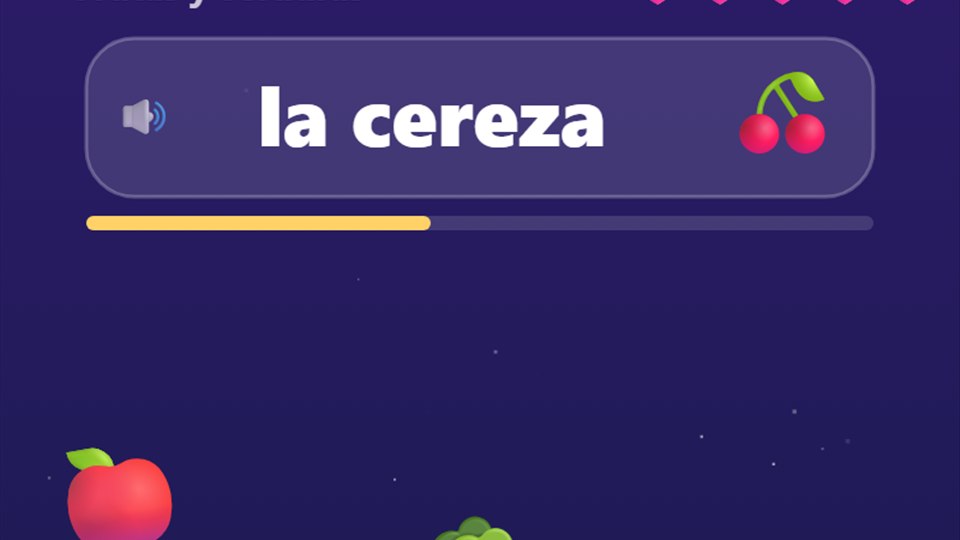
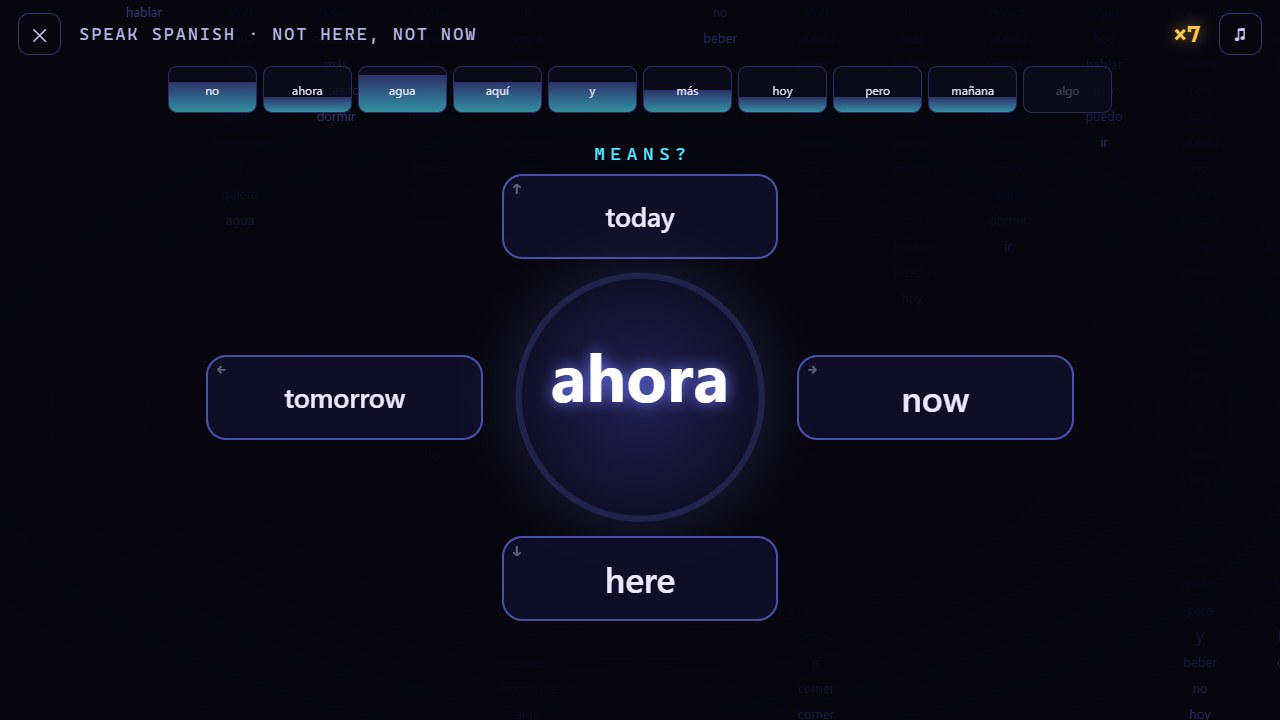
A fast memory game. Pick a deck and it gives you a packet of five to ten new things, then asks for each one again and again at growing gaps: first with the answer lit up, then from two choices, from four, backwards, against look-alikes, and last with the choices hidden for a moment, so that you have to recall it. Quick and right moves a thing up a step. Wrong, or out of time, and the answer lights up for you to press, and that thing comes back sooner. In Speak Spanish the things are 100 everyday words and phrases in ten packets. Once you hold the words of a sentence, whole sentences made from them turn up, to read or to say in Spanish, and each packet ends with a proof: five sentences the game has not shown you. Spanish words you already know teaches 24 ending swaps, such as -tion to -ción, and tries each one on words nobody taught you. The same game has decks for Japanese hiragana, the Russian alphabet, Morse code, Braille and 30 capital cities. The next day the menu offers a short review of whatever is starting to fade.
What you practise
- Speak Spanish: 100 everyday words and phrases in ten packets, from quiero (I want) to quería (I wanted)
- Building sentences from a few parts: I want, I can, I need, I am going to and I have to, each followed by any verb
- Asking questions with qué, dónde, cuándo and por qué, and saying no with no
- Soy and estoy, tengo and hay, and the forms for you, he, she and we
- 350 short sentences to read and to say, made only from words already taught
- 24 ending swaps between English and Spanish, such as -tion to -ción, -ity to -idad and -ly to -mente, tried on 396 real words
- Other decks in the same game: Japanese hiragana (46 signs), the Russian alphabet (33 letters), Morse code by ear, Braille letters and 30 capital cities that people often get wrong
- Recalling instead of re-reading, and coming back to review: after a day, then 3, 7, 16, 35 and 80 days
How to play
Press DOWNLOAD on a deck to start its next packet. Answer with the arrow keys, with W, A, S and D or with 1 to 4, or click or tap the answer. The ring around the middle is the clock. After a miss the right answer lights up: press it to carry on. In the Spanish decks, click or tap the middle to hear the Spanish again. The X in the corner goes back to the menu and the note button turns the sound off. When something is due for review, its deck shows a RESYNC button.
For teachers and parents
- One packet is one sitting: up to ten new things, then five proof questions. Stop there and come back the next day for the review.
- After every sentence the game takes it apart word by word, for example quiero = I want · comer = to eat. Have students say the whole sentence aloud before they pick.
- Describing words are given in both forms (cansado / cansada, listo / lista). Ask each student which one they would say about themselves.
- The ending swaps work on thousands of words, but not on every word. Can the class find one that breaks a rule? (Serious is serio, not serioso.)
- The Spanish is spoken by the device's own Spanish voice, so how it sounds depends on the device. With no Spanish voice the game still works, in silence.
- The Morse code deck is learned by ear and needs the sound on.
- Progress is kept in the browser on that device. The day after a packet the menu marks its words as fading and offers a RESYNC.