Eat Up
Start at the bottom of a food chain and eat your way to the top.
Open Eat Up full screenProgress is saved in this browser only.
What it is
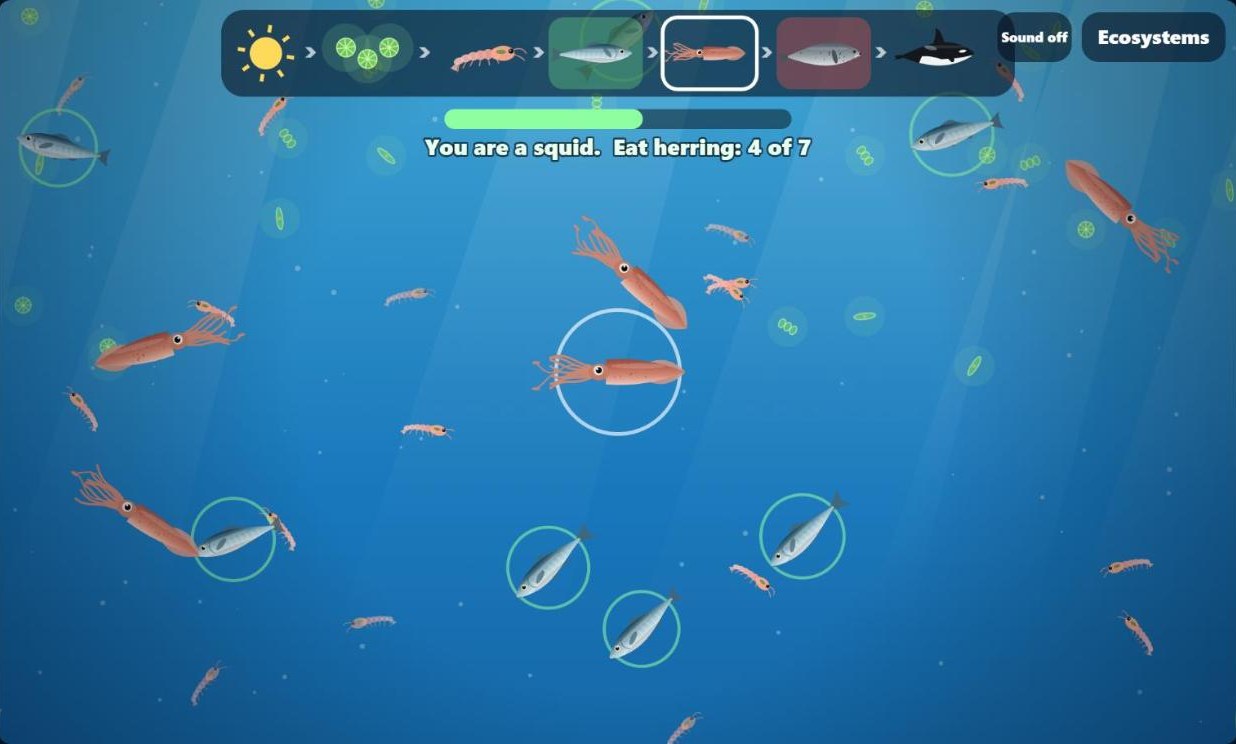
Pick the open ocean, a freshwater pond or the African savanna. You begin as the small animal that eats the producer (krill, a tadpole or a grasshopper) and steer it around a large living scene. Eat enough of the link below you and you grow into the next animal in the chain, all the way up to the top predator: orca, river otter or martial eagle. The animal one link above you hunts you, and the other animals hunt each other too. Every animal attacks and defends the way the real one does: a squid throws out two tentacles and hides behind a cloud of ink, a dragonfly nymph shoots out its folding lip, a bluegill raises its spines, a grasshopper jumps, a snake strikes and hisses, a mongoose dives into a burrow. You use the same moves, and a sentence about the real animal comes up the first time you meet each one. The menu is a world map with a pin where each food chain lives (the North Atlantic off Norway, eastern North America, the Serengeti in East Africa), and a small map stays in the corner while you play. PLAY ONLINE is a race up the chain: the other players are animals in your water, and the food chain applies to them too. A strip along the top always shows the whole chain, starting at the sun, with what you eat in green and what eats you in red. Eating is a quick gulp and a puff of bubbles or dust; nothing graphic is shown.
What you practise
- A food chain starts with a producer that makes its own food from sunlight (5-PS3-1)
- Energy and matter pass from producer to consumer to consumer (5-LS2-1)
- Each animal eats particular things: a squid cannot live on plankton
- Animals have body parts and behaviours that help them catch food and stay alive: tentacles, ink, spines, a shooting jaw, a jump, a warning hiss, a burrow (4-LS1-1)
- Where in the world each ecosystem is
- There are fewer animals at each step up the chain, because less energy reaches it
- Three real chains: phytoplankton, krill, herring, squid, seal, orca; algae, tadpole, dragonfly nymph, bluegill, bass, otter; grass, grasshopper, lizard, snake, mongoose, eagle
- Decomposers return nutrients to the producers (on the ending screen)
How to play
Move the mouse or drag a finger where you want to go, or use the arrow keys. Green rings and a green arrow mark your food; red dashed rings and a red arrow mark what hunts you, and the screen edge glows red when one is close. Space, a click or the red button uses your attack; X, a right click or the blue button uses your defence. A red exclamation mark over a hunter means it is about to use its own attack. If you are caught you start that animal again; nothing else is lost. The Sound button turns the voice and effects off. PLAY ONLINE needs no account: QUICK MATCH finds a match, MAKE A ROOM gives a four-letter code for friends to type in. The room picks the ecosystem, players get a made-up name, and the match ends soon after the first player becomes the top predator.
For teachers and parents
- In the ocean and the pond the producers only live near the bright surface. Ask why.
- Count the animals: lots of krill, a few seals, two orcas. Where did the energy go?
- Touching the wrong food brings up a line such as "Seals do not eat krill". What would happen to the seals if the squid disappeared?
- Play two ecosystems and line the chains up side by side. Which animal in the pond does the same job as the herring in the ocean?
- The ending names decomposers. Where would they go on the chain?
- Pick one animal and name the body part it uses to catch food and the one it uses to get away. Which animals have no attack, and which have no defence? Why?
- Find each ecosystem on a globe. What is the weather like there?
- Online, only the players are shared: each screen has its own wild animals, so two players will not see the same fish.
- For a class race, one player presses PLAY ONLINE, then MAKE A ROOM, and reads out the four letters. Up to 20 can join.
More like this