Home › History › Across Africa
Across Africa
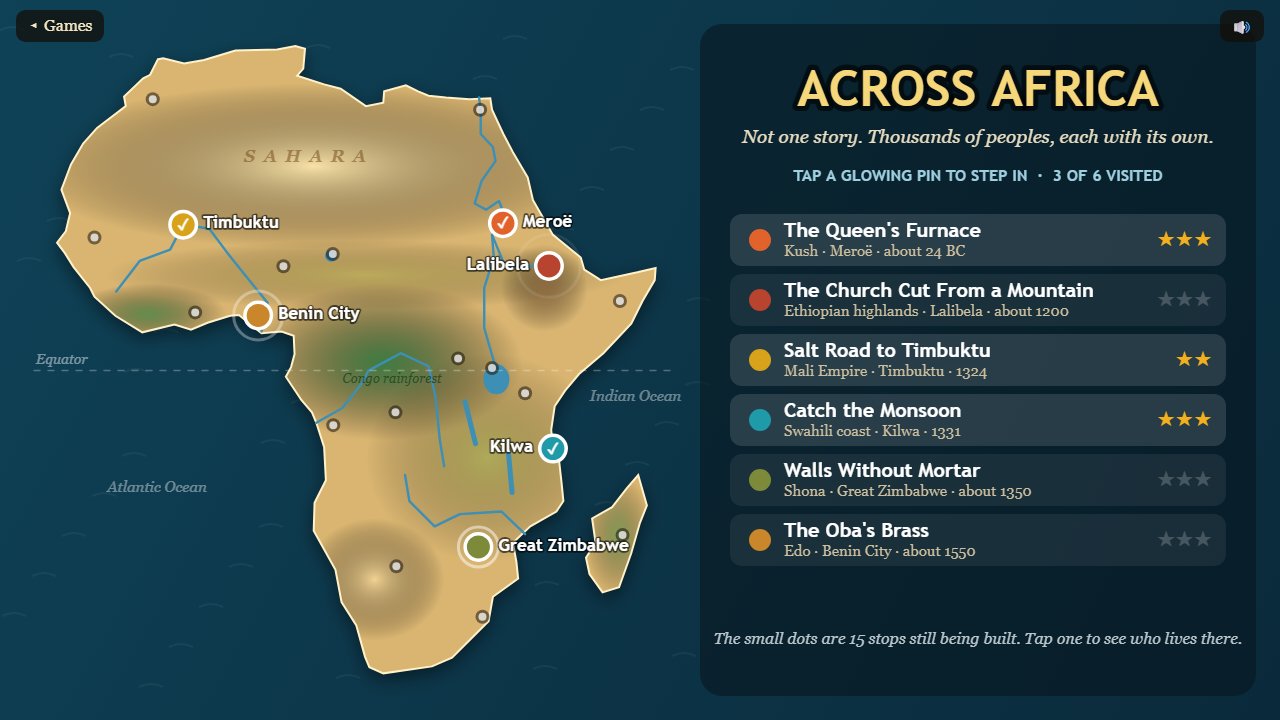
Six places on the map of Africa, six moments in history, and a job to do by hand in each one.
Open Across Africa full screenProgress is saved in this browser only.
What it is
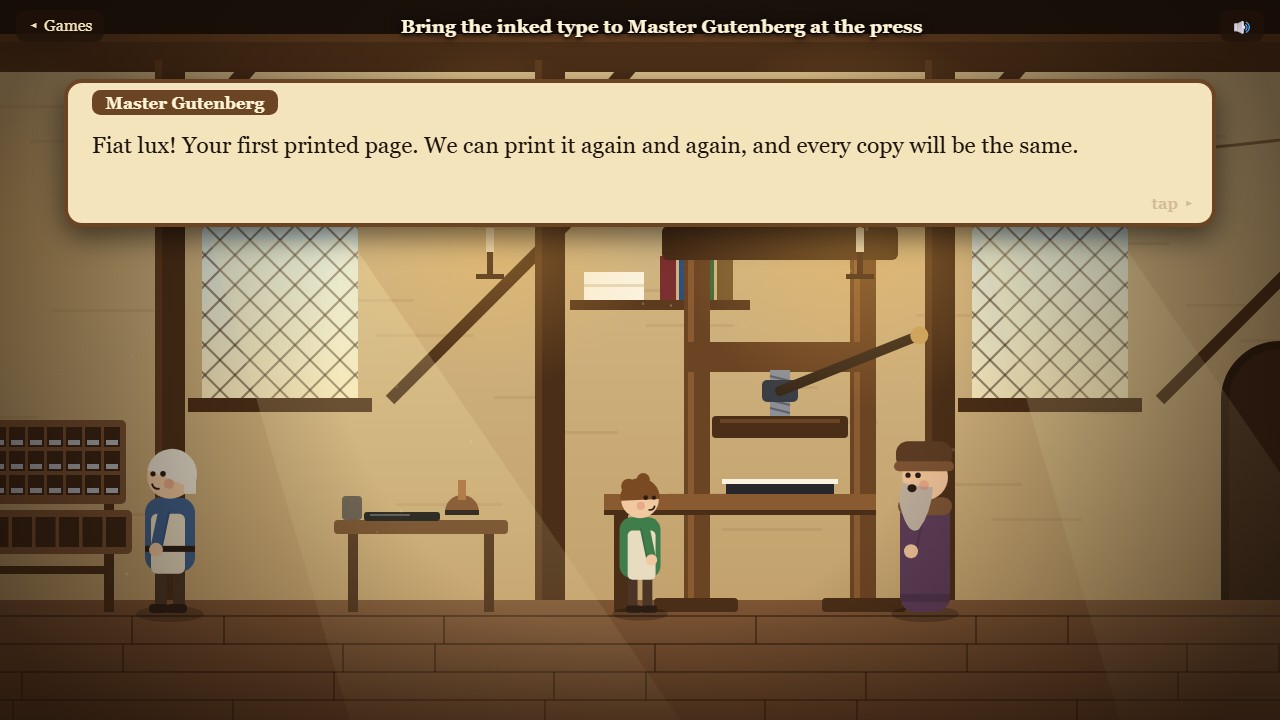
A map of Africa with six pins. Each pin is a people, a place and a year, and tapping it puts you there with work to do. In Meroë, about 24 BC, you load an iron furnace, work the bellows and hammer the glowing iron while a Roman army waits on the border of Kush. At Lalibela in Ethiopia, about 1200, you chisel a church out of solid rock from the roof down. In 1324 you lead a salt caravan across the Sahara to Timbuktu with water for six days. At Kilwa in 1331 you pick the month to sail and steer a trading dhow to India on the monsoon wind. At Great Zimbabwe, about 1350, you split granite with fire and water and lay a wall that stands with no mortar. In Benin City, about 1550, you cast a brass leopard by the lost-wax method. After each job come three questions and a journal page: what really happened, who lives there today, and which parts of the story were made up. When all six are done, The Long View asks you to put them in time order. Fifteen more peoples are marked on the map as grey dots; they are not built yet.
What you practise
- Six African kingdoms, cities and peoples, from Kush on the Nile to the Kingdom of Benin, over more than 1,500 years
- How things were made and done: smelting iron, cutting a church from rock, crossing a desert from well to well, sailing with the monsoon, building in stone with no mortar, lost-wax casting
- Trade tied the continent to the wider world: salt and gold across the Sahara, gold, ivory, cloth and porcelain across the Indian Ocean
- Finding each place on the map of Africa and naming the country it is in today
- Putting events in time order, from about 24 BC to about 1550
- The peoples in the game are still there: who lives in each place today
- Telling the real people and events from the made-up parts of a history story
How to play
Tap a coloured pin on the map, or a name in the list beside it. Tap, or press Space or Enter, to move the talk along. Each job says what to do in a strip at the bottom of the screen: tap, drag across the rock, hold to keep a fire burning or to pour, and steer the ship with a finger, the mouse or the arrow keys. A wrong move costs nothing but a star; you carry on from where you were. The Map button leaves a stop and the speaker button turns the sound off. The game is wide, so hold a phone sideways.
For teachers and parents
- The caravan does not take the shortest line to Timbuktu. Ask why before the journal explains it.
- At Lalibela the roof is finished first and the floor last. Why does a church cut from rock have to be made in that order?
- In the wall at Great Zimbabwe a joint may never sit on top of a joint. Look at a brick wall nearby: is it built the same way?
- A coin from Kilwa was found at Great Zimbabwe. Find both on the map. What does that say about who traded with whom?
- Each journal says which characters were made up and what nobody knows. Why should a history game say so?
- The journal for Benin says many of its brass works are in museums far away, and that some are being returned. What does the class think should happen to the rest?
- The grey dots are peoples the game does not cover yet. Pick one and find out one true thing about it.
More like this